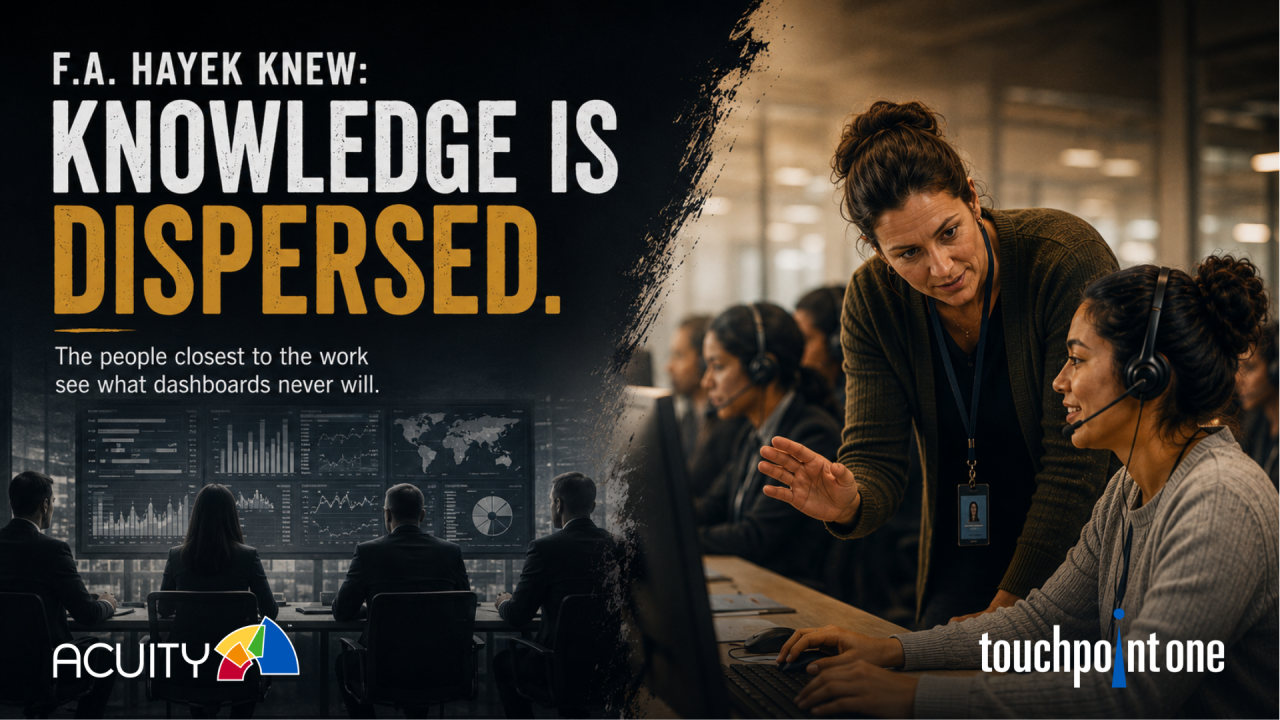
In 1945, economist Friedrich Hayek published an essay arguing that the central problem of economic planning isn't allocating known resources. It's that the knowledge needed to make good decisions is dispersed, local, and often impossible to articulate. No central planner can aggregate it fast enough or accurately enough to outperform the decentralized actors who actually possess it.
The contact center industry has been proving him right for decades.
Most performance management platforms are built on the assumption that headquarters knows best. Coaching plans get generated centrally and pushed down. Scorecards are designed by operations and quality leadership and applied uniformly across every team, covering everything from CSAT and efficiency to productivity, attendance, and other behavioral KPIs. Gamification, when it exists at all, runs on corporate-defined schedules with corporate-defined rules. The supervisor becomes an enforcement layer rather than a decision-maker. Data flows up. Directives flow down. The local knowledge that would make any of it work gets discarded along the way.
This is the Soviet bread line model of performance management. Technically operational. Deeply inefficient. Demoralizing to everyone forced to participate.
Think about what the supervisor running a team on a Tuesday afternoon actually knows. Which agent is struggling with something personal. Who just took a rough call and needs five minutes. Which two people are quietly competitive with each other and will perform better in a head-to-head. What the floor energy feels like right now, three hours into the shift. None of this shows up on a corporate dashboard. None of it can be captured by a centrally designed coaching workflow. And all of it matters more than the directive coming down from headquarters about Q3 quality initiatives.
One of Hayek's most important insights was about prices. He didn't mean prices as numbers on a tag. He meant prices as the purest expression of local knowledge: thousands of individual buyers and sellers each acting on information specific to their own circumstances, and the price emerging as a real-time signal that captures all of it. No central authority could ever assemble that picture. The market does it automatically because the knowledge stays where it lives.
There is no closer analog in the contact center than a live customer call. A specific agent, a specific customer, a specific issue, a specific moment. The full context exists nowhere else and never will again. This is where AI applied to live interaction analysis becomes genuinely consequential. It is not centralized intelligence pushed outward. It is local intelligence captured at the source and made available to the people who can act on it.
The symbiosis is what makes it work. A supervisor and an AI agent on the front lines see some of the same things, but not all of the same things. The AI catches what the human misses: tonal patterns across hundreds of calls, compliance signals buried in transcript data, micro-trends in handle time that won't surface on any dashboard for weeks. The human catches what the AI cannot: a hesitation in someone's voice that isn't in the data, a pattern of behavior that signals a problem at home, the difference between an agent who needs feedback and an agent who needs a break. Each brings senses the other lacks. Together they form a unified source of local intelligence that neither could produce alone. That is the real promise of AI in this domain, and it only emerges when both are operating at the edge.
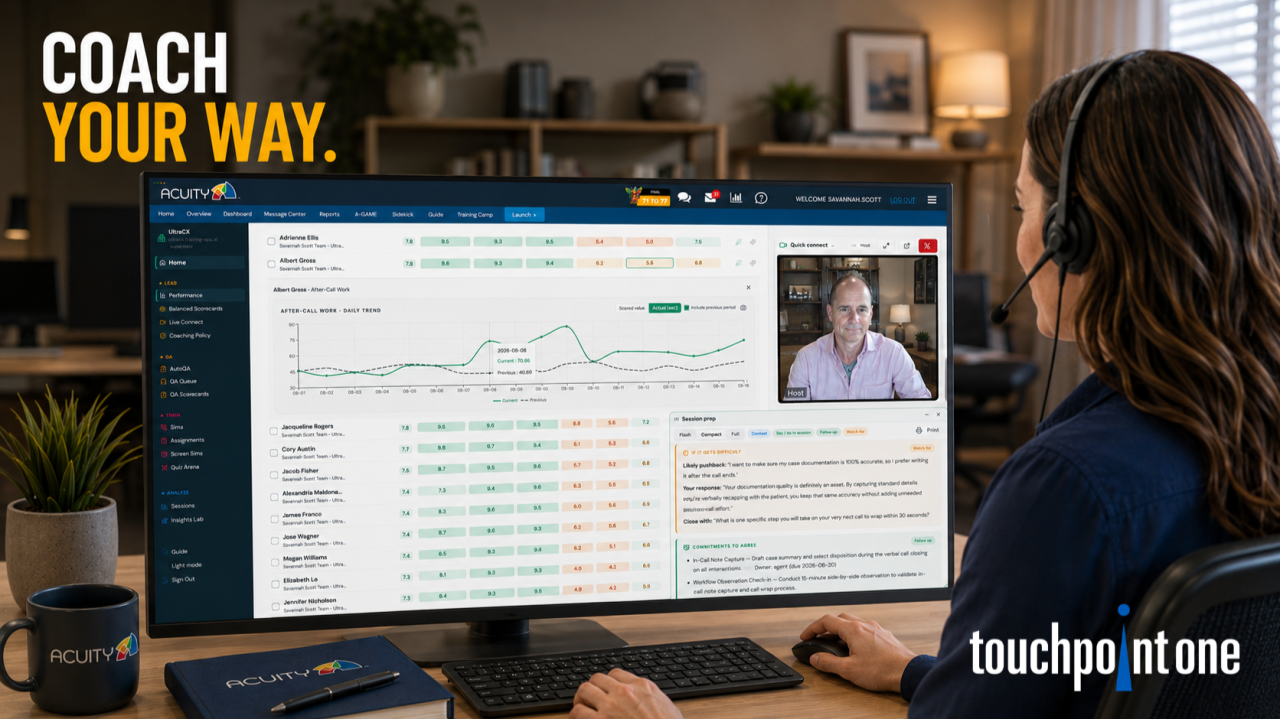
Acuity is built around this principle. A-GAME Flex lets supervisors stand up a competition in minutes based on what they're observing that day, without filing a request or waiting for corporate approval. Sidekick gives supervisors the performance intelligence they need to support their teams and treats their judgment as the operative variable. Acuity AI Studio takes each organization's proprietary scoring logic, coaching methodology, and operational context as inputs that shape what the AI produces. The intelligence is decentralized to the organization, then further decentralized to the supervisor and agent.
There's a reason engagement keeps declining across the industry despite billions invested in performance management technology. Most of that technology is built to centralize control, and centralization is exactly the wrong response to a problem rooted in distributed local knowledge.
Eighty years ago, an economist few in CX reads explained why the systems we keep building keep failing. The supervisors closest to the work know things headquarters will never know. The agent on a live call knows things the supervisor will never know. The AI alongside them catches signals neither would catch alone. Build for that or keep wondering why the dashboards look fine and the people are leaving.
If any of this sounds like the contact center you're running or the one you're trying to fix, let's talk. We've spent years building Acuity around the idea that the people closest to the work should have the tools to act on what they see. The conversation is usually a good one! 😁
-Greg
“Acuity has made life so much easier for the leadership team! Having a balanced scorecard is a necessity in our environment.“
- Brandi Stadie, Senior Director of MTM Contact Center Operations, Phoenix, AZ
“With TouchPoint One's advanced platforms and expertise, we've seamlessly integrated gamification into our performance management, boosting employee engagement and efficiency.“
- Mark Wilson, Chime Solutions CEO
“We are saving ourselves so much time and so many headaches. It is just a better way to work.”
- Tereasa M. Vukanovich, Manager, Regulatory Compliance & Audit