—New study confirms the psychological mechanisms behind effective gamification, and why most implementations fall short—
It's rare to see rigorous academic research on gamification in contact centers. So when a peer-reviewed study in Frontiers in Psychology validates the exact mechanisms that TouchPoint One has built into its gamification solutions and identifies the specific gaps that cause most gamification to fail, it gets our attention and perhaps yours too.
The January 2026 study, "Gamified Human Resource Management as a Driver of Employee Engagement Through Intrinsic Motivation," provides empirical evidence for what our clients have experienced firsthand. Gamification works when it addresses genuine psychological needs. And it fails when it doesn't.
Using data from 418 respondents and structural equation modeling, researchers confirmed:
🔎Reading the Research: The notation "β = 0.31" means that for every one-unit increase in gamified HRM implementation, work engagement increases by 0.31 units—a moderate to strong positive effect. The "p < 0.001" means there's less than a 0.1% chance this result occurred by random chance—in other words, it's statistically significant and highly reliable.
The study directly addresses what they call the "entertainment trap" - the concern that gamification trivializes work. Their finding? When properly designed and organizationally supported, gamification creates meaningful engagement, not superficial compliance.
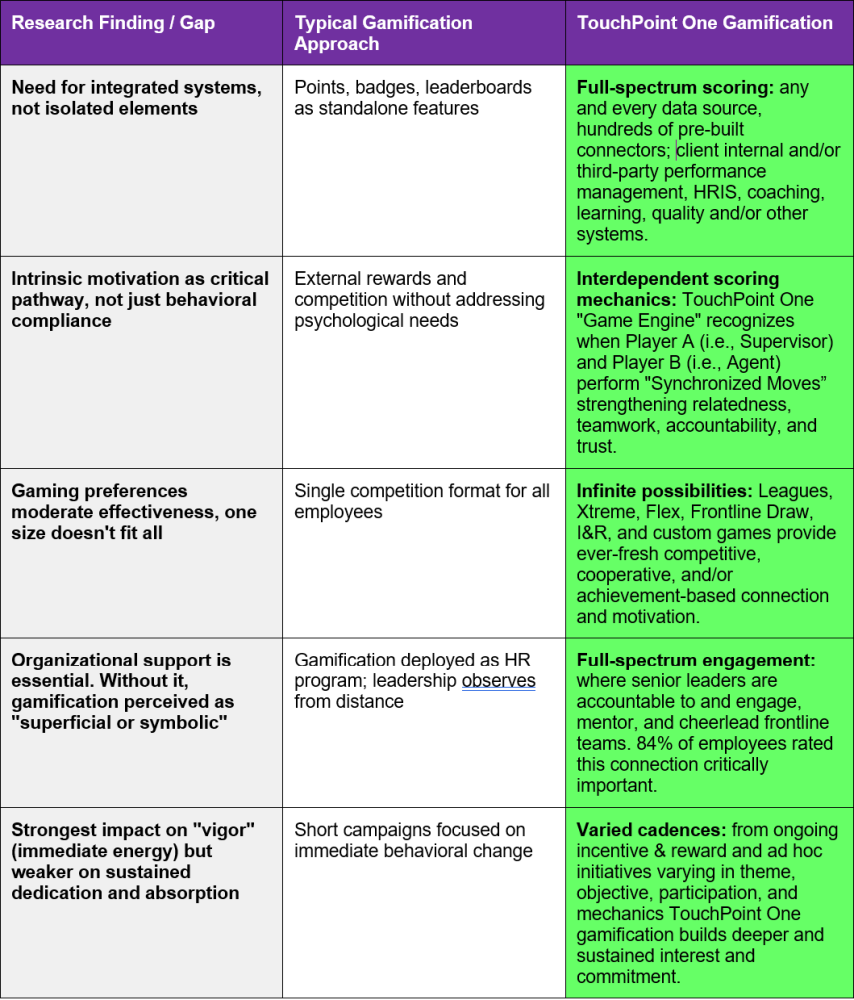
Here's where the research gets specific. The study identifies critical limitations in typical gamification:
The researchers found that gamification's strongest impact was on "vigor" (immediate energy) but weaker on sustained dedication and absorption, precisely why TouchPoint One gamification offers a highly diversified, dynamic, flexible, and tailored gamification approach.
The research documented a β = 0.31 effect size for gamified HRM on work engagement. TouchPoint One clients have seen this translate into business outcomes:
What the research found in controlled studies, our clients have validated in real-world contact center operations across multiple industries.
The study's conclusion challenges the "entertainment trap" criticism directly: "The two perspectives are not inherently contradictory but rather contingent upon the alignment of institutional design and organizational climate."
In other words, gamification isn't frivolous when it's built on sound psychological principles and embedded in genuine organizational support. It becomes frivolous when it's just points and badges slapped onto existing processes – the very model upon which nearly every gamification solution is founded.
The researchers identify this as the critical moment:
"AI investment advances rapidly while employee engagement strategies remain stagnant."
Contact centers need infrastructure that strengthens human capability. Not entertainment, but genuine psychological support that enables people to thrive alongside AI.
This research provides independent academic validation using rigorous scientific methods. The study's findings don't just support TouchPoint One's approach, but explain why it works and identify the specific mechanisms that separate effective gamification from superficial implementations.
When contact centers face the choice between basic performance visibility and advanced AI features, the research confirms what our clients have discovered — the foundational infrastructure for human engagement matters more. And gamification, properly implemented, is essential infrastructure, not a mere nice-to-have feature.
Contact centers preparing for AI need the data infrastructure to feed AI and the human infrastructure to make sure people thrive alongside it.
TouchPoint One builds both — performance management systems that produce AI-ready data and gamification mechanics grounded in the psychological principles this research validates. Few organizations do both. Fewer still tailor the blend to each client's specific operation.
If you're looking for a partner who treats data readiness and human engagement as inseparable priorities, we should talk.